
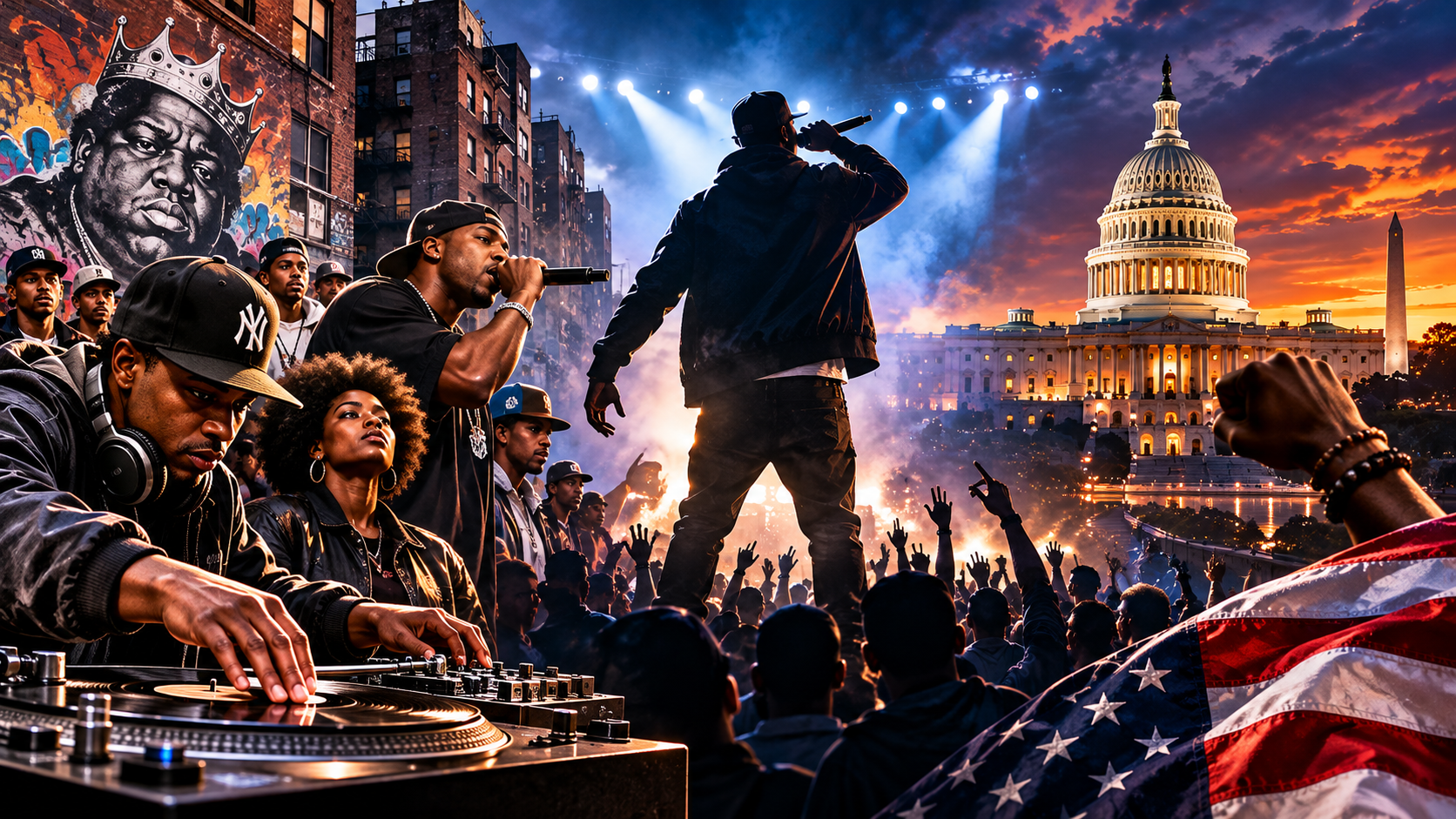
Before hip-hop became a multibillion-dollar cultural industry, before rappers appeared at presidential events, before corporations built advertising campaigns around its influence, and before politicians began debating its impact on American society, hip-hop was developing in communities whose experiences rarely received sustained national attention.
In the Bronx during the 1970s, young people transformed turntables, records, microphones, dance floors, and neighborhood gatherings into the foundation of a new cultural movement. DJs extended rhythmic breaks, MCs developed increasingly elaborate vocal performances, dancers created new forms of physical expression, and graffiti writers established visual identities across the urban landscape.
What emerged was more than a musical genre. Hip-hop became a means of storytelling, competition, community recognition, and cultural participation.
As the movement expanded, it increasingly became a vehicle for examining poverty, policing, racial inequality, urban neglect, and political authority. Artists used commercially distributed records to describe experiences that traditional political institutions and major news organizations did not always prioritize.
Hip-hop did not invent political music. Gospel, blues, jazz, folk, soul, reggae, and other traditions had long addressed oppression, resistance, and social change. But hip-hop developed a distinctive language for examining urban America, combining direct narration, rhythmic intensity, sampling, and the perspective of communities often discussed by outsiders rather than represented in their own words.
The political significance of hip-hop was never simply that rappers criticized government. It was that millions of listeners encountered political and social realities through the voices of people describing their own environments.
Understanding that influence requires examining the history of the culture, the artists who challenged authority, the controversies surrounding their work, and the complicated relationship between political expression and commercial success.
The Bronx and the Conditions That Helped Produce Hip-Hop
Hip-hop’s early development cannot be separated from the economic and social conditions of New York City during the 1970s.
The Bronx experienced severe challenges associated with disinvestment, housing deterioration, poverty, population changes, and the broader fiscal crisis affecting New York City.
These conditions did not mean the borough lacked cultural vitality. Its communities possessed rich musical traditions influenced by African American, Caribbean, and Latino experiences.
Block parties and neighborhood gatherings became important spaces for artistic experimentation.
DJ Kool Herc, whose Jamaican background influenced his approach to sound-system culture, is widely recognized as a pioneering figure in hip-hop’s development. Afrika Bambaataa and Grandmaster Flash also played major roles in shaping the emerging culture through musical innovation, organization, and performance.
These pioneers did not establish a formal political organization. Their primary contributions involved music, entertainment, community participation, and creative experimentation.
Nevertheless, the movement developed in a social environment where questions about economic opportunity, public services, neighborhood identity, and institutional neglect were difficult to ignore.
Hip-hop offered young people opportunities to create cultural value with resources available to them.
Turntables became instruments. Existing recordings became raw material for new compositions. Local performers developed reputations through skill, originality, and the ability to command an audience.
In communities where access to established cultural institutions could be limited, hip-hop provided alternative pathways to recognition.
That foundation would later become important to the culture’s political influence.
When Hip-Hop Began Reporting on Social Conditions
One of the most consequential early recordings in hip-hop history was Grandmaster Flash and the Furious Five’s 1982 release, “The Message.”
Rather than focusing primarily on celebration or lyrical competition, the recording offered a stark account of urban hardship and psychological pressure.
Its importance extended beyond its commercial reception.
“The Message” demonstrated that rap music could function as social commentary, describing conditions that listeners might recognize from their own neighborhoods while introducing those experiences to audiences unfamiliar with them.
This development helped establish a model for later artists who used music to discuss housing conditions, crime, poverty, addiction, and public institutions.
Hip-hop could entertain while also providing a form of social documentation.
That did not make every lyric a verified account of public policy or community conditions. Music is an artistic medium, and performers use exaggeration, fictional narration, metaphor, and personal perspective.
But the cultural importance of these recordings came partly from their ability to make listeners confront experiences that were often missing from mainstream representations of American life.
Rap music became a space where social problems could be discussed without first passing through the editorial priorities of traditional media.
Public Enemy Turned Political Confrontation Into a Musical Identity
By the late 1980s, hip-hop had developed artists whose work placed political criticism at the center of their public identities.
Few groups demonstrated this approach more forcefully than Public Enemy.
Led by Chuck D, with Flavor Flav contributing a distinctive performance presence, Public Enemy combined aggressive production, historical references, racial commentary, and confrontational political language.
Albums such as It Takes a Nation of Millions to Hold Us Back and Fear of a Black Planet challenged listeners to consider media representation, institutional racism, historical memory, and political authority.
Public Enemy’s production team, the Bomb Squad, created dense sonic arrangements that reinforced the urgency of the group’s messages.
Their music did not resemble a conventional political lecture. It was loud, rhythmically complex, provocative, and designed to command attention.
That combination helped bring political commentary to audiences who might never attend a policy seminar or read an academic analysis of American race relations.
Public Enemy also demonstrated the risks associated with confrontational political expression.
The group faced controversy over statements by members and associates, including criticism involving antisemitism. Those controversies remain part of its history and should not be overlooked when evaluating its cultural influence.
Political music can challenge injustice while still requiring scrutiny of its claims, rhetoric, and conduct.
That principle is essential to any serious examination of politically engaged hip-hop.
N.W.A. and the Debate Over Policing
While Public Enemy developed an explicitly political identity, N.W.A. brought a different form of confrontation to national attention.
Emerging from Compton, California, the group portrayed street life, police encounters, violence, and institutional conflict through an aggressive style that became central to the development of gangsta rap.
The group’s 1988 recording “Fuck tha Police” became particularly controversial because of its direct hostility toward law enforcement.
In 1989, the FBI sent a letter to the group’s record distributor expressing concern about the song’s message.
The letter became an important episode in the history of government responses to controversial popular music.
For supporters, N.W.A.’s work expressed frustration with aggressive policing and experiences that they believed were inadequately acknowledged by public officials.
For critics, the group’s lyrics raised concerns about glorifying violence, hostility toward police officers, and the broader social effects of inflammatory language.
The debate exposed a recurring tension in American culture: the distinction between describing social conflict, expressing anger about it, and encouraging harmful conduct.
That distinction is not always easy to establish through isolated lyrics.
Nevertheless, the controversy demonstrated that hip-hop had become influential enough to attract attention from federal authorities and national political commentators.
A musical movement that began in neighborhood gatherings was now part of a larger debate over public order, constitutional expression, and institutional accountability.
Hip-Hop, Censorship, and the First Amendment
As rap music gained commercial influence, disputes over explicit lyrics and controversial subject matter intensified.
Artists faced criticism concerning profanity, sexuality, violence, and political expression. Advocacy groups, lawmakers, parents, and media organizations debated whether record labels and performers should face greater restrictions.
These disputes intersected with broader questions about the First Amendment.
The Constitution places significant restrictions on government censorship, but constitutional protections do not prevent private citizens, businesses, or organizations from criticizing music or deciding what they wish to distribute.
That difference is important.
Government punishment for protected expression raises different legal questions from a radio station declining to play a recording or a private retailer deciding not to stock an album.
Hip-hop’s censorship controversies therefore involved multiple issues: artistic freedom, commercial distribution, community standards, public criticism, and the boundaries of government authority.
Artists frequently argued that their work reflected social realities rather than creating them.
Critics responded that cultural products can influence public attitudes and should not be exempt from scrutiny.
Both positions contributed to debates about the responsibilities of artists and the rights of audiences.
The lasting significance of these controversies is that hip-hop became a prominent arena for testing American attitudes toward controversial expression.
From Protest Music to Electoral Politics
As hip-hop audiences grew, political organizations and candidates increasingly recognized the culture’s ability to reach younger voters.
Artists participated in voter registration campaigns, public-service initiatives, political events, and issue-based advocacy.
Hip-hop also developed relationships with elected officials, political campaigns, and nonprofit organizations seeking to engage communities that conventional political messaging sometimes struggled to reach.
These relationships were not always comfortable.
An artist’s endorsement of a candidate could attract attention, but it could also raise questions about political knowledge, personal interests, or whether celebrity influence was being substituted for substantive policy discussion.
Likewise, politicians who embraced hip-hop culture sometimes faced criticism for appearing interested in its audience without adequately addressing the concerns of the communities associated with it.
The relationship between hip-hop and electoral politics therefore requires careful evaluation.
Cultural influence can encourage political participation, but popularity does not automatically produce expertise.
An entertainer may have an informed position on public policy, or may speak primarily from personal experience. Either contribution should be evaluated according to its substance rather than accepted solely because of the speaker’s fame.
The same standard should apply to politicians who seek cultural credibility through relationships with prominent artists.
The Commercial Success That Changed Hip-Hop’s Political Role
Hip-hop’s expansion into mainstream entertainment created enormous opportunities for artists, producers, executives, and entrepreneurs.
The culture influenced fashion, advertising, sports, television, film, technology, and consumer branding.
Artists who began their careers describing economic hardship sometimes became owners of substantial businesses and valuable intellectual property.
This transformation created an important tension.
Hip-hop’s early political influence often came from its ability to criticize institutions and economic conditions. Its later commercial success increasingly connected prominent artists to corporations, investment opportunities, luxury products, and wealthy social networks.
Commercial success does not necessarily eliminate political independence.
Artists can accumulate wealth while continuing to advocate for social change. They can also use financial resources to support education, criminal justice initiatives, community organizations, and business development.
But commercial relationships can influence incentives.
A performer with major endorsement agreements, corporate partnerships, and extensive business interests may face different pressures from an independent artist whose work depends on a smaller audience.
The issue is not whether successful artists should be criticized for becoming wealthy.
It is whether economic success changes the way political messages are produced, distributed, and received.
Hip-hop’s evolution demonstrates how a culture can challenge established power while eventually becoming part of the institutions it once criticized.
Social Media Gave Hip-Hop New Political Reach
Digital platforms transformed the relationship between artists and audiences.
Rappers no longer needed to rely exclusively on radio stations, record labels, television networks, or print publications to communicate political opinions.
An artist could address millions of followers directly through social media, podcasts, livestreams, or independently released recordings.
This development expanded opportunities for political expression and community engagement.
It also created new challenges.
Political claims can circulate rapidly without verification. Personal disputes can become public controversies. Complex policy issues may be reduced to short clips designed for attention rather than understanding.
Social media rewards visibility, but visibility is not the same as accuracy.
An artist with a large audience may introduce followers to an important issue, yet that audience still needs reliable information to evaluate the claims being presented.
The responsibility for independent thinking ultimately belongs to the listener.
Hip-hop can encourage people to question authority, but questioning authority should also involve examining evidence and challenging unsupported claims, including those made by admired performers.
Hip-Hop’s Political Influence Extends Beyond Elections
One of the most significant contributions of hip-hop to American public life is its ability to shape how communities understand themselves.
Music can preserve local history, document social experiences, and introduce listeners to perspectives outside their own environments.
Hip-hop has provided language for discussing poverty, racial identity, incarceration, policing, education, economic ambition, and community responsibility.
It has also created opportunities for disagreement within the culture.
Some artists emphasize systemic injustice. Others focus on personal accountability, entrepreneurship, family stability, or criticism of political leadership.
These perspectives do not always align neatly with conventional political categories.
That diversity is important because hip-hop is not a political party, and its audience does not possess a single ideology.
The culture includes people with different economic interests, religious beliefs, social values, and political commitments.
Treating hip-hop as though it speaks with one political voice overlooks the very independence that helped make it influential.
Its broader contribution lies in expanding the range of voices participating in public debate.
The Urban Politicians Perspective
Hip-hop’s political importance cannot be measured solely by campaign endorsements, protest recordings, or the number of rappers who become involved in electoral politics.
Its influence is more fundamental.
Hip-hop helped establish a cultural platform through which communities could describe their experiences, challenge public narratives, question institutions, and participate in conversations about American society.
At its strongest, the culture encourages listeners to examine the relationship between power and everyday life.
At its weakest, it can reproduce the same misinformation, commercial pressures, and superficial political arguments found elsewhere in public discourse.
That contradiction does not diminish hip-hop’s historical significance. It demonstrates why the culture deserves serious analysis rather than automatic celebration or condemnation.
Artists should be free to express political opinions. Audiences should be equally free to challenge those opinions.
Political engagement becomes more meaningful when cultural influence is accompanied by historical knowledge, credible evidence, and a willingness to consider competing arguments.
Hip-hop did not replace traditional political institutions.
It changed who could participate in the conversation.
And in a democracy, expanding the conversation can be a powerful development.
Free your mind. Think independently.
Has hip-hop become more politically influential as it has grown into a global industry, or has commercial success weakened the independent voice that made the culture powerful in the first place?





Leave a Reply