

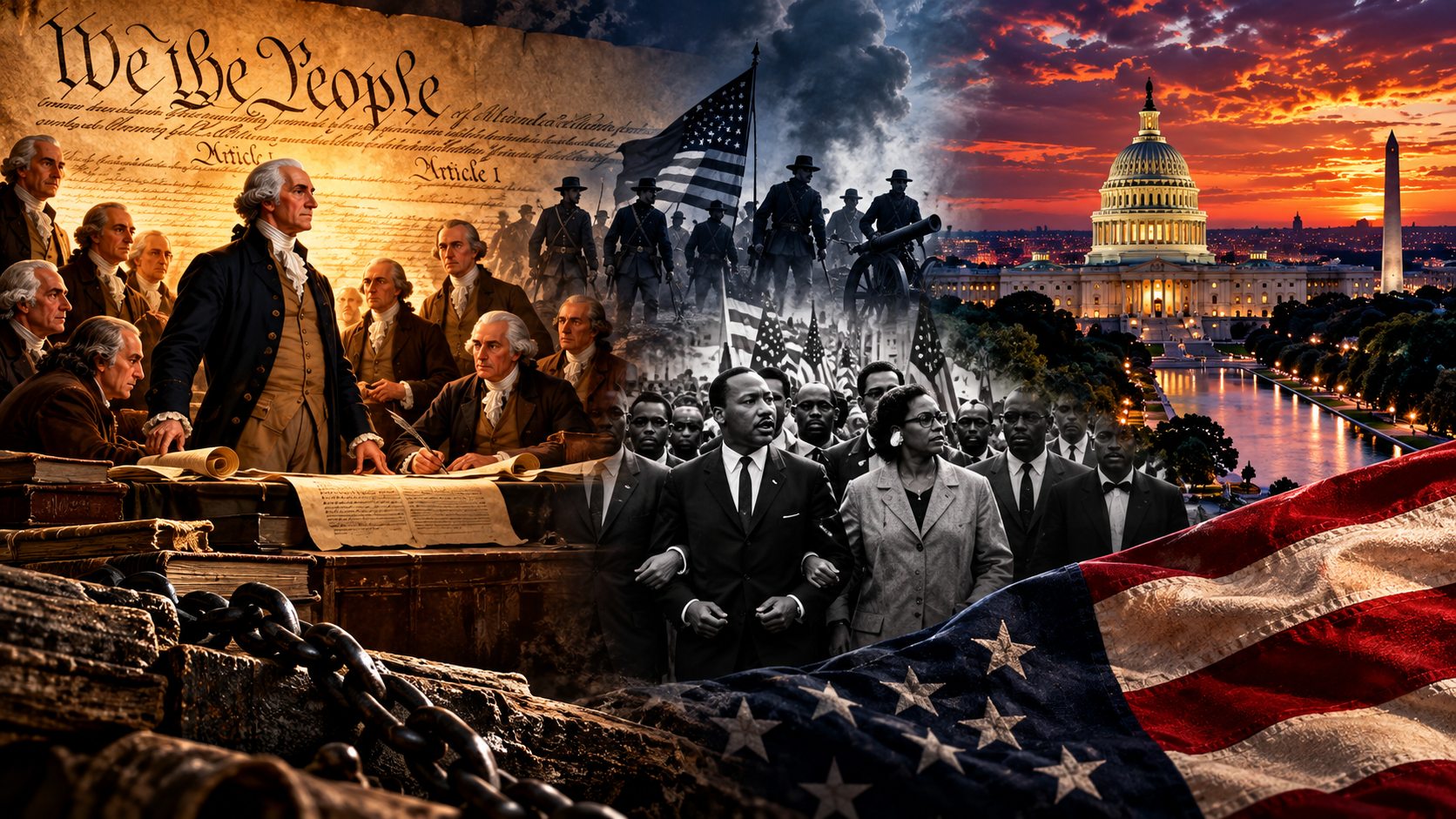
Americans often discuss politics as though the country’s most important disagreements began with the last presidential election. Political parties battle over voting rights, immigration, economic opportunity, education, federal authority, and the meaning of freedom. Each controversy is presented as an urgent struggle over the nation’s future, with commentators frequently suggesting that the country has entered an entirely new political era.
But many of America’s most contentious political questions are far older than the politicians currently debating them.
The relationship between federal and state authority, the struggle over citizenship, the distribution of economic opportunity, and the meaning of equal protection have shaped American politics for generations. These issues did not emerge overnight, and they cannot be fully understood through contemporary campaign speeches or partisan arguments.
To understand why Americans disagree so passionately about the present, it is necessary to examine the decisions, institutions, and conflicts that shaped the past.
History does not determine every political outcome, but it establishes many of the conditions under which modern political decisions are made.
That distinction matters. Understanding historical influence is not the same as believing America is incapable of change. It means recognizing that laws, economic arrangements, political institutions, and cultural assumptions often outlive the generations that created them.
The Constitution Created a Government—and an Enduring Political Debate
The United States Constitution established a federal republic built around representative government, separated powers, and a division of authority between the national government and the states.
The framers sought to create a government strong enough to function while limiting the concentration of political power. The resulting constitutional structure reflected competing concerns about liberty, public authority, regional interests, and political representation.
Those disagreements were not permanently resolved in 1787.
The Constitution established institutions that could adapt through legislation, judicial interpretation, political practice, and formal amendment. It also left important questions to future generations.
How much authority should the federal government exercise over state governments? When should national standards override local preferences? How should individual liberties be protected when democratic majorities support restrictions?
These questions continue appearing in debates over education, elections, environmental regulation, healthcare, and civil rights.
Consider the relationship between state and federal governments. States exercise substantial authority over public education, elections, policing, and numerous other matters. Yet federal constitutional protections and valid federal laws can constrain how states exercise that authority.
Political arguments about states’ rights therefore cannot be separated from the larger constitutional question of which government possesses authority over a particular issue.
The answer depends on constitutional text, legislation, judicial precedent, and the specific circumstances involved.
Understanding this history makes it easier to recognize when politicians are discussing genuine constitutional disputes and when they are using constitutional language primarily as a political slogan.
Slavery Exposed the Contradictions of American Freedom
The founding generation proclaimed principles of liberty and political equality while permitting slavery to remain deeply embedded in American society.
That contradiction was not incidental to the country’s development.
Slavery shaped agriculture, commerce, wealth accumulation, congressional representation, territorial expansion, and the balance of political power between different regions.
The Constitution’s original Three-Fifths Clause counted three-fifths of the enslaved population for purposes of representation and direct taxation, despite denying enslaved people political freedom and meaningful representation of their own.
This arrangement increased the political representation of slaveholding states relative to what it would have been if enslaved people had not been counted at all.
The expansion of slavery into western territories later became one of the central political conflicts of the nineteenth century.
Compromises intended to preserve the Union repeatedly postponed rather than resolved the fundamental disagreement over slavery’s future.
Eventually, the conflict contributed to the Civil War.
The war and the abolition of slavery transformed the constitutional order, but emancipation did not immediately create equal citizenship or equal access to political and economic institutions.
That struggle continued during Reconstruction and far beyond it.
Reconstruction Changed the Constitution, but Its Promises Were Contested
Following the Civil War, the United States adopted three constitutional amendments that fundamentally altered American law.
The Thirteenth Amendment abolished slavery and involuntary servitude, except as punishment for a crime following conviction. The Fourteenth Amendment established important protections involving citizenship, due process, and equal protection. The Fifteenth Amendment prohibited denying voting rights on account of race, color, or previous condition of servitude.
Together, these amendments established a constitutional foundation for a more inclusive democracy.
Reconstruction also witnessed significant Black political participation. African Americans voted, held public office, organized communities, and helped shape new state governments across the South.
Yet these developments faced intense resistance.
White supremacist violence, political intimidation, discriminatory laws, and changes in federal enforcement undermined many Reconstruction-era gains.
Following the end of Reconstruction, Southern states developed systems of racial segregation and disenfranchisement that became central features of Jim Crow.
The consequences extended beyond the ballot box. Segregated schools, restricted employment opportunities, discriminatory public policies, and unequal access to institutions shaped the circumstances under which families and communities lived.
This history matters because constitutional rights and the practical ability to exercise those rights are not always identical.
A legal protection can exist on paper while institutional barriers, intimidation, or discriminatory practices prevent people from enjoying its full benefits.
The history of Reconstruction demonstrates that democratic progress depends not only on adopting legal principles but also on enforcing them.
The Civil Rights Movement Reshaped American Democracy
The modern civil rights movement challenged discriminatory institutions through litigation, organizing, boycotts, marches, voter registration efforts, journalism, and sustained political pressure.
Its achievements were not the product of one speech, one leader, or one political party.
Organizations, local activists, attorneys, religious communities, students, labor supporters, and countless ordinary citizens contributed to a movement that transformed American public life.
The Civil Rights Act of 1964 prohibited discrimination in important areas of public life, including employment and public accommodations. The Voting Rights Act of 1965 established federal protections against racial discrimination in voting and created enforcement mechanisms designed to address entrenched barriers.
These laws were major achievements, but their passage did not end political disagreement over civil rights.
Questions concerning enforcement, federal oversight, equal treatment, and the appropriate remedies for discrimination continued to evolve.
The Supreme Court’s 2013 decision in Shelby County v. Holder, for example, invalidated the coverage formula used to determine which jurisdictions were subject to the Voting Rights Act’s preclearance requirement.
The decision did not eliminate the Voting Rights Act, but it significantly changed the operation of that federal oversight system.
Supporters of the decision emphasized constitutional limits on differential treatment of states and the need for congressional justification based on contemporary conditions. Critics argued that removing the coverage formula weakened an important safeguard against discriminatory voting changes.
Understanding the historical purpose of the Voting Rights Act is essential to evaluating these competing positions.
Without that context, the debate can appear to concern only election administration rather than the longer struggle over access to democratic participation.
Economic History Helps Explain Today’s Inequalities
Political history and economic history are inseparable.
Government decisions have influenced land ownership, transportation, education, taxation, banking, housing, employment, and the development of American industries.
Some policies expanded economic opportunity. Others excluded particular populations or distributed benefits unevenly.
Housing offers a revealing example.
During the twentieth century, federal housing programs, private lending practices, local zoning policies, and racially restrictive arrangements influenced where Americans could purchase homes and accumulate property wealth.
Historical redlining and discriminatory mortgage practices limited access to credit and homeownership in many communities.
Because home equity became an important source of household wealth for millions of Americans, unequal access to housing markets could produce consequences extending across generations.
Families able to purchase homes in appreciating neighborhoods often gained opportunities to build equity, finance education, or transfer assets to their children.
Families excluded from those opportunities faced different economic circumstances.
This does not mean every present-day difference in wealth can be attributed to a single historical policy. Contemporary income, education, family circumstances, market conditions, personal decisions, and many other factors also matter.
It does mean that evaluating economic opportunity without considering the historical development of property ownership and credit markets produces an incomplete picture.
The same principle applies to education, employment, and infrastructure.
Policies adopted decades ago can shape the opportunities available to communities long after the original policymakers have left office.
Political Parties Have Changed, Even When Their Names Have Not
One of the most common mistakes in political discussion is assuming that today’s Democratic and Republican parties are ideologically identical to the parties that existed a century ago.
American political parties have undergone substantial changes in their voter coalitions, regional support, policy priorities, and ideological identities.
During the nineteenth century, Republicans became associated with opposition to the expansion of slavery, while Democrats included powerful Southern constituencies committed to preserving slavery.
Over subsequent generations, industrialization, economic crises, the New Deal, the civil rights movement, and changing regional political loyalties reshaped the parties.
The Democratic coalition increasingly included Black voters and supporters of federal civil rights protections, while many conservative white Southern voters gradually shifted toward the Republican Party.
These changes did not occur simultaneously, uniformly, or without exceptions. Political realignment was a complex process unfolding across multiple decades.
Recognizing this evolution is important because historical party labels alone cannot establish what a modern political party believes or represents.
A more meaningful analysis examines the policies, coalitions, institutions, and political choices of each historical period.
History becomes less useful when it is reduced to a competition over which contemporary party can claim credit for past achievements or assign blame for past injustices.
The Power of Historical Narratives
History influences politics not only through laws and institutions but also through the stories Americans tell about their country.
Different generations emphasize different national experiences.
Some narratives focus on constitutional liberty, economic innovation, military sacrifice, and democratic achievement. Others emphasize slavery, dispossession, discrimination, labor struggles, and the long fight to extend constitutional protections.
These perspectives need not be mutually exclusive.
A serious understanding of American history recognizes both the country’s achievements and its failures.
The United States developed influential democratic institutions while also maintaining systems that denied fundamental rights to large portions of its population.
Americans expanded political participation through constitutional amendments, legislation, and civic movements, often after prolonged resistance.
Economic growth created enormous opportunities while producing inequalities and disputes over the distribution of its benefits.
A historical account that acknowledges only national accomplishments is incomplete. So is an account that ignores reform, institutional change, and the achievements of people who challenged injustice.
The objective should not be to construct a national story designed to flatter or condemn every generation.
It should be to understand what happened, why it happened, and how its consequences continue to shape the country.
Why Historical Literacy Matters in the Information Age
Americans now encounter political arguments through television, podcasts, websites, social media platforms, and increasingly sophisticated digital content.
Historical references circulate rapidly, often without the context necessary to evaluate them.
A quotation from a founding figure may be separated from the circumstances in which it was written. A court decision may be described without explaining its legal reasoning. A political movement may be reduced to a handful of personalities rather than examined through its broader social and institutional history.
These shortcuts can make complicated historical subjects appear deceptively simple.
They also create opportunities for selective storytelling.
Political advocates may highlight evidence supporting their preferred interpretation while ignoring facts that complicate it.
The remedy is not to assume that every interpretation deserves equal credibility. Historical claims should be evaluated according to the quality of their evidence, the reliability of their sources, and their consistency with the broader historical record.
Primary documents, scholarly research, court opinions, legislative records, and credible historical institutions provide essential tools for that work.
Independent thinking does not require rejecting established knowledge. It requires understanding how conclusions are reached and remaining willing to revise them when better evidence emerges.
The Urban Politicians Perspective
America’s past continues influencing its present because institutions, economic arrangements, constitutional principles, and political traditions persist across generations.
The Constitution still structures public authority. Reconstruction amendments continue shaping civil rights law. The legacy of segregation remains relevant to discussions of housing and educational opportunity. The civil rights movement transformed democratic participation. Historical party realignments help explain the political coalitions Americans recognize today.
None of this means that history makes change impossible.
On the contrary, American history demonstrates that political institutions can be challenged, laws can be amended, and public attitudes can evolve.
But meaningful change is difficult to achieve when citizens do not understand the systems they are attempting to reform.
Political education therefore requires more than memorizing dates or celebrating familiar historical figures. It requires examining relationships between past decisions and present conditions, identifying what has changed, and recognizing what remains unresolved.
At Urban Politicians, history is not simply a record of what happened before we arrived.
It is a tool for understanding the forces shaping the world we inhabit.
A society that does not understand its past risks mistaking inherited problems for entirely new ones—and overlooking the lessons of earlier generations that confronted them.
Free your mind. Think independently!
Which chapter of American history do you believe has the greatest influence on today’s political debates—the founding era, Reconstruction, the New Deal, or the civil rights movement?





Leave a Reply